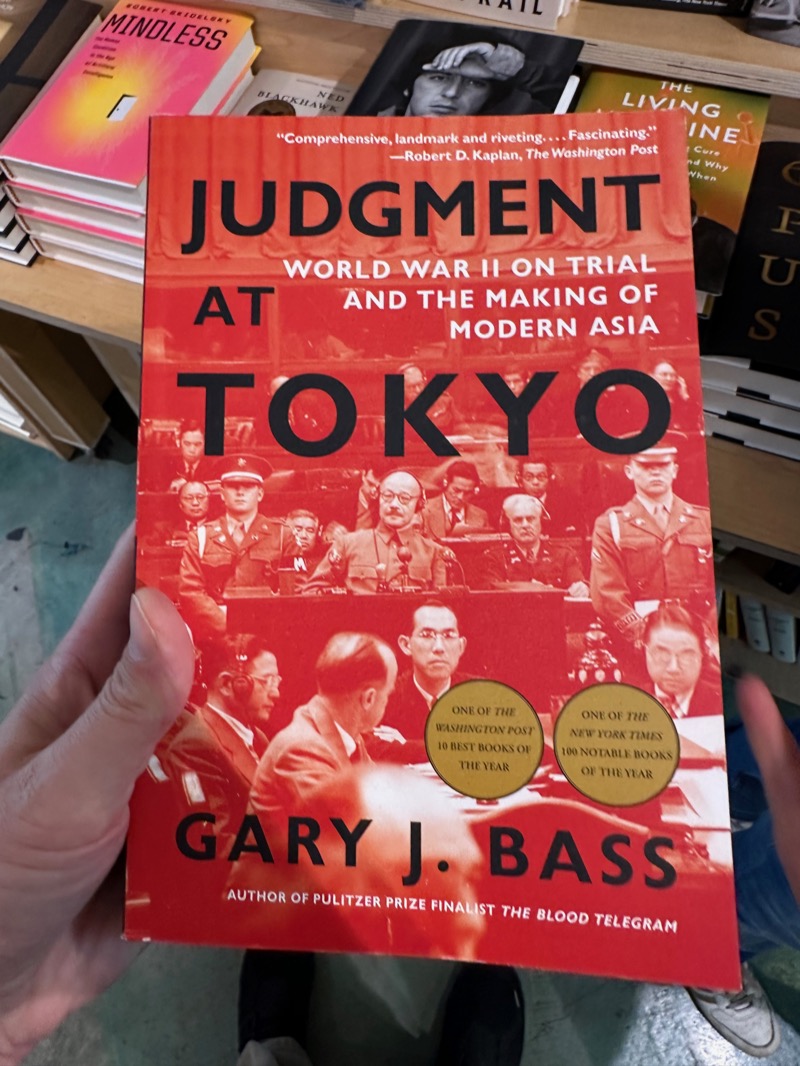
Last year I read Gary Bass' "Judgment at Tokyo," and it changed how I think about the institutional foundations of the Pacific order. The book is a detailed, often granular account of the International Military Tribunal for the Far East, the Pacific counterpart to Nuremberg. Bass spent years in the archives, and the result is a work that takes the tribunal seriously as an institution rather than treating it as a foregone conclusion or a historical footnote.
The tribunal tried 28 defendants, convicted 25, and sentenced seven to death by hanging, including former Prime Minister Tojo Hideki. It sat for over two and a half years, heard testimony from more than 400 witnesses, and compiled a documentary record that ran to tens of thousands of pages. The majority opinion alone was over a thousand pages long. Bass documents all of this with the patience of a historian who believes the details matter, and the details do matter, because the gap between what the tribunal actually did and what most people think it did is one of the more consequential distortions in the postwar historical record.
The tribunal's work was serious. It engaged with questions of command responsibility, aggressive war, and the legal boundaries of state violence in ways that were genuinely novel for the time. The prosecution built cases linking individual defendants to systematic atrocities across the Pacific: the Bataan Death March, the Rape of Nanking, the treatment of prisoners of war, the forced labor programs. The evidence was extensive, and much of it was drawn from Japanese military records that the occupation authorities had seized before they could be destroyed. Bass argues that the tribunal, for all its flaws, produced a factual record of the war that remains valuable precisely because it was compiled under conditions of institutional rigor, with defense counsel, cross-examination, and dissenting opinions.

The dissents are where the book becomes most interesting. Justice Radhabinod Pal of India wrote a lengthy dissent arguing that the tribunal lacked jurisdiction, that the charges of aggressive war were retroactive, and that the Allied powers' own conduct (including the atomic bombings of Hiroshima and Nagasaki) should have been subject to the same legal standards. Justice Bert Roling of the Netherlands dissented on narrower grounds but also raised questions about the selectivity of prosecution. Bass does not dismiss these arguments. He takes them seriously as legal and moral positions while also documenting the political contexts in which they were made. Pal's dissent, in particular, has had a long afterlife: it has been embraced by Japanese nationalists as vindication, by postcolonial scholars as a critique of Western hypocrisy, and by international lawyers as an early articulation of principles that later found broader acceptance.
The point Bass makes, and the one that stayed with me, is that the tribunal's actual work has been overtaken by simplified narratives. On one side, the tribunal is dismissed as victor's justice: a show trial in which the outcome was predetermined and the legal reasoning was retroactive. On the other side, it is treated as settled moral vindication: the moment when the civilized world held Japan accountable. Neither narrative does justice to what actually happened in the courtroom. The proceedings were messier, more substantive, and more legally ambitious than either summary allows. The dissents were genuine, the legal questions were hard, and the evidentiary record was real. Reducing the tribunal to "victor's justice" erases the substantive work. Treating it as unambiguous vindication ignores the legitimate questions the dissenters raised.

This matters beyond legal history because the contested memory of the tribunal shapes the political space within which Pacific alliances operate today. Japan's relationship with its wartime history is not a matter of academic interest to the commanders and diplomats who manage the US-Japan alliance. When Japanese politicians visit the Yasukuni Shrine, which enshrines convicted war criminals alongside ordinary war dead, the reaction from China and South Korea is not performative; it reflects genuine grievance rooted in living memory and national narrative. When China invokes the "century of humiliation" to justify its military buildup and its territorial claims, it is drawing on a historical narrative that the Tokyo tribunal was supposed to have settled but did not. When the Philippines weighs the costs and benefits of its alliance with the United States, it does so against a backdrop of remembered liberation, remembered occupation, and remembered abandonment.
Bass's book made me think differently about what it means to manage alliances in a theater where the parties remember the same history differently. The Pacific is not like NATO, where the founding narrative (collective defense against Soviet aggression) is shared by all members. In the Pacific, the foundational events of the postwar order, the war, the occupation, the tribunals, the peace treaties, are remembered through national lenses that often contradict each other. A military commander or diplomat working in this theater is not operating on shared historical ground. The ground itself is contested, and the contest is not over. The tribunal was supposed to establish a common factual record. In many ways it did. But the record has been interpreted so differently by the nations that participated in it that the common ground it established has largely eroded. That erosion has consequences for every conversation happening in the Pacific today.